
From ancient shamanic rituals in Atacama and West Africa to modern French precision lutherie, explore the history,...
shopping_cart
Cart
0

From ancient shamanic rituals in Atacama and West Africa to modern French precision lutherie, explore the history,...

Meditation is based on a specific quality of attention that is often misunderstood. It is not about clearing the mind...
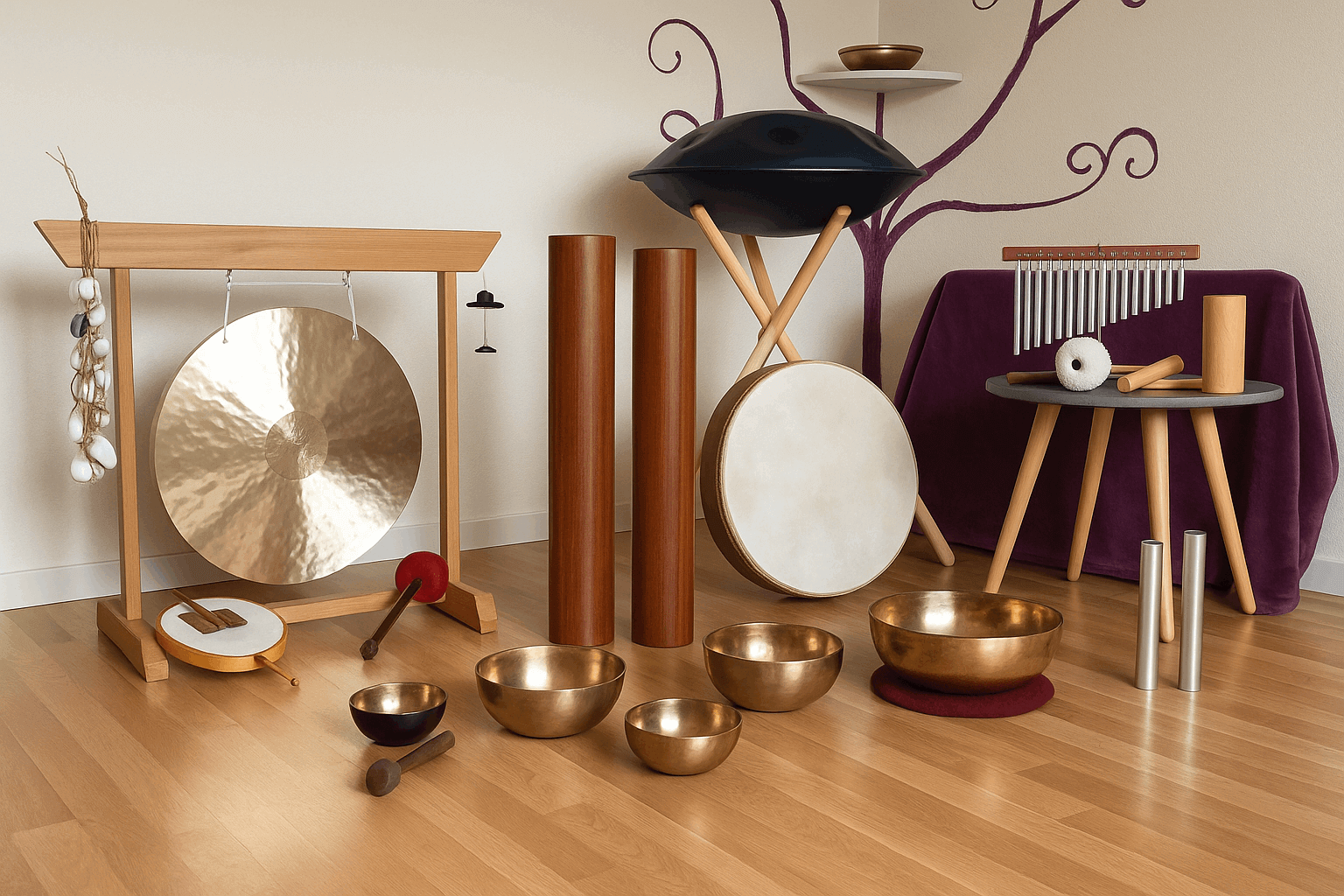
Sound therapy, relaxation and vibrations: discover how the Rain Pillar can accompany sound baths, meditation and...

In the workshop, every rainstick is born from a precise gesture and patient listening. From the wood processing to...

Elevate the guest experience at your luxury spa, hotel, or high-end boutique with our French artisanal rainsticks. An...
Sound therapy refers to a range of practices that use sound, music and vibration as supports for relaxation, listening and refocusing. Bowls, gongs, tuning forks, chimes, drums, voice and flowing-sound instruments can be combined to create an environment that encourages release and attention to sensation.
Among these instruments, the handcrafted Rain Pillar has a distinctive place. Its slow, continuous flow naturally evokes rainfall and creates a gentle sound presence that can last for several minutes. This continuity makes it particularly interesting for sound baths, meditation, relaxation practices or simply moments when we want to slow down and listen differently.
Sound therapy, sometimes also referred to as sonology depending on the practice, uses sound and vibration within a wellness context. A practitioner may introduce different instruments around a person to create a sound bath combining frequencies, rhythms, resonances and silence. The experience is not limited to hearing: some vibrations, particularly lower ones, can also be perceived physically.
This sensory dimension helps explain the interest in sound-based practices. Listening engages attention, memory, emotion and different mechanisms of the nervous system. It can also change the way we perceive our surroundings and our own internal state.
The effects of sound are studied from the perspectives of psychology, neuroscience and physiology. Music and certain forms of sound stimulation are among the subjects of research into attention, emotions and different indicators associated with stress. Heart rate, breathing and some hormonal markers are among the parameters examined in these studies.
The relationships between music, emotion and neurochemical mechanisms are also widely studied. However, it would be too simplistic to attribute the release of dopamine, serotonin or oxytocin mechanically to a particular instrument. During a sound therapy session, the experience depends on many factors, including context, quality of listening, duration, sound intensity, rhythm and each person's individual sensitivity.
The autonomic nervous system is another important area of research. A slow, regular and non-intrusive sound environment can accompany a state of relaxation and slowing down. Some studies also examine brain activity during listening. Alpha waves, often associated with relaxed wakefulness, are observed in some research on relaxation. This does not mean that a particular instrument automatically produces them: sound accompanies an experience rather than controlling a specific physiological state on its own.
Research on music and sound-based interventions has examined their use in relation to stress, anxiety and the perception of pain. Other studies focus on relaxation, sleep quality or physiological markers associated with stress. Results can vary considerably depending on the type of intervention, the context and the people involved.
Some sound therapy approaches also use terms such as self-regulation or self-healing to describe the sense of returning to balance that can accompany deep relaxation. These terms belong to the vocabulary used by some practitioners and do not mean that a sound instrument treats or cures an illness. In this context, they refer more to a search for calm, release and greater inner availability.
The relationships between stress, hormones, the nervous system and the immune system are also broad areas of research. In the context of sound practice, it is more accurate to describe an environment that may support relaxation and well-being than to attribute a specific medical effect on immunity to sound itself.
The Rain Pillar is based on the acoustic principle of the traditional rainstick: small seeds or other moving elements gradually travel through a resonant body, meeting a succession of internal obstacles. The many small impacts create a flowing sound that naturally evokes rainfall. The history of the rainstick and its origins is more complex than is sometimes suggested, but this long-established acoustic principle can still be found in different forms of instrument today.
At the workshop, the contemporary Rain Pillar is handcrafted to produce a prolonged flow of sound. The shape of the instrument, its internal structure and the elements moving inside it all contribute to its acoustic behaviour. This handcrafted making process brings together work on the material and on the sound itself.
Closing your eyes while listening to a Rain Pillar can change the way you perceive the space around you. Its continuous rustling sound, made up of countless small irregular impacts, creates a sound texture without a fixed melody or imposed rhythm. It can provide a point of attention while remaining discreet enough not to dominate the listening experience.
Sounds of rain, water and other natural environments are frequently used to accompany relaxation, concentration or the transition towards sleep. The Rain Pillar offers something different from a recording: its sound is created directly by the movement of material and changes slightly with every flow.
This quality can also be used as a support for meditation or mindfulness practice. The sound then becomes a point of attention: we listen as it appears, develops and gradually fades, without necessarily trying to produce a particular effect.
During a sound relaxation session, one of the main qualities of the Rain Pillar is its continuity. A rainfall sound that unfolds over time gives listening a chance to settle. Some people may experience less mental agitation, slower breathing or a gradual sense of muscular release. The experience remains individual: everyone responds differently to sounds, volume levels and frequencies.
The flowing sound can also help shift attention away from external stimulation and a constant stream of thoughts. This quality helps explain its use in sound baths, massage, meditation and periods of rest. For some people, listening can become highly immersive and accompany a state somewhere between calm alertness and drowsiness.
Some practitioners also place sound work within a more energetic framework and refer to chakras, the circulation of energy or a search for overall harmony. These ideas belong to their respective practice frameworks. The Rain Pillar can be used within them as an instrument for listening, transition and accompaniment.
The Rain Pillar is particularly flexible in sound therapy practice. At the beginning of a session, it can gradually establish a listening atmosphere. During a sound bath, its continuous flow can form a background over which bowls, gongs, chimes or other instruments are introduced. At the end of a session, it can also accompany the return to a calmer and more familiar listening environment.
Sound duration then becomes a practical tool. An instrument that can continue for several minutes without constant handling allows the practitioner to focus on the session and on other instruments. The 15-minute Rain Pillar, for example, can be integrated into sound therapy, music therapy, relaxation or sound bath practices that call for a longer acoustic presence.
At home, the use can be much simpler. A few minutes of listening can mark the transition between daytime and evening, accompany breathing practice, meditation or a bedtime ritual. Research on music and sleep produces varying results depending on the person and the protocol, but a regular relaxation ritual can be a simple way to prepare gradually for rest.
There is therefore no universal duration after which the body automatically enters a particular state. Five, ten or fifteen minutes can be experienced very differently depending on the person, the context and the intention behind the listening.
Sound therapy is above all an experience of listening, sensing and allowing sound the time to take its place. In this context, the Rain Pillar offers a distinctive texture that is continuous, natural in character and subtly changing. It can accompany sound therapy, meditation, massage, a sound bath or simply a few quiet minutes at home.
Its purpose is not to promise healing or mechanically trigger a particular physiological state. Its value lies in creating a listening environment that can support slowing down, refocusing and relaxation. This meeting point between acoustics, well-being and the physical presence of the object is also central to the Rain Pillar concept.
Rain column and meditation: a natural sound support for mindfulness
check_circle
check_circle