
Making things in a way that feels right to us
We care about well-made objects, fine craftsmanship and pieces that are as meaningful in their use as they are in their appearance. That is naturally how we approached the Rainpillar project: searching for a beautiful sound, paying close attention to every detail and finish, and enjoying the process of making something that others will, in turn, enjoy using.
This level of care has guided the project from the beginning. It influences the way we design our instruments, choose our materials, make each piece and, quite simply, work with our customers.
Made in Montpellier to keep full control of the process
Mickaël Amant is an artisan craftsman, a cabinetmaker specialising in fine furniture restoration, and a musician. His skills and experience are at the heart of the project.
We therefore chose to design and make our Rainpillars in his workshop in Montpellier, France. This allows us to keep control of every stage of production, from the first acoustic tests through to assembly and finishing.
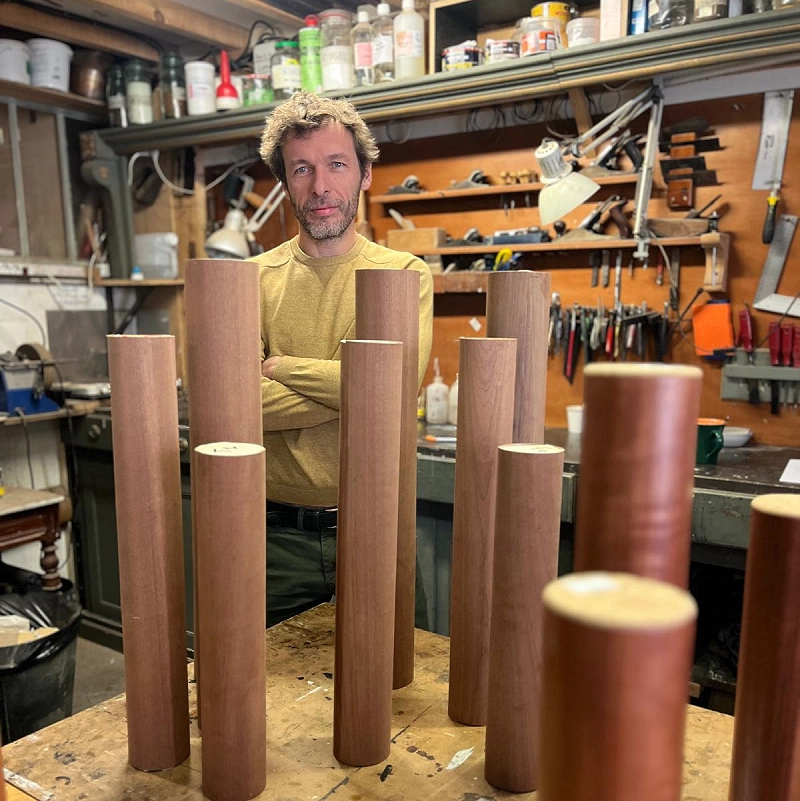
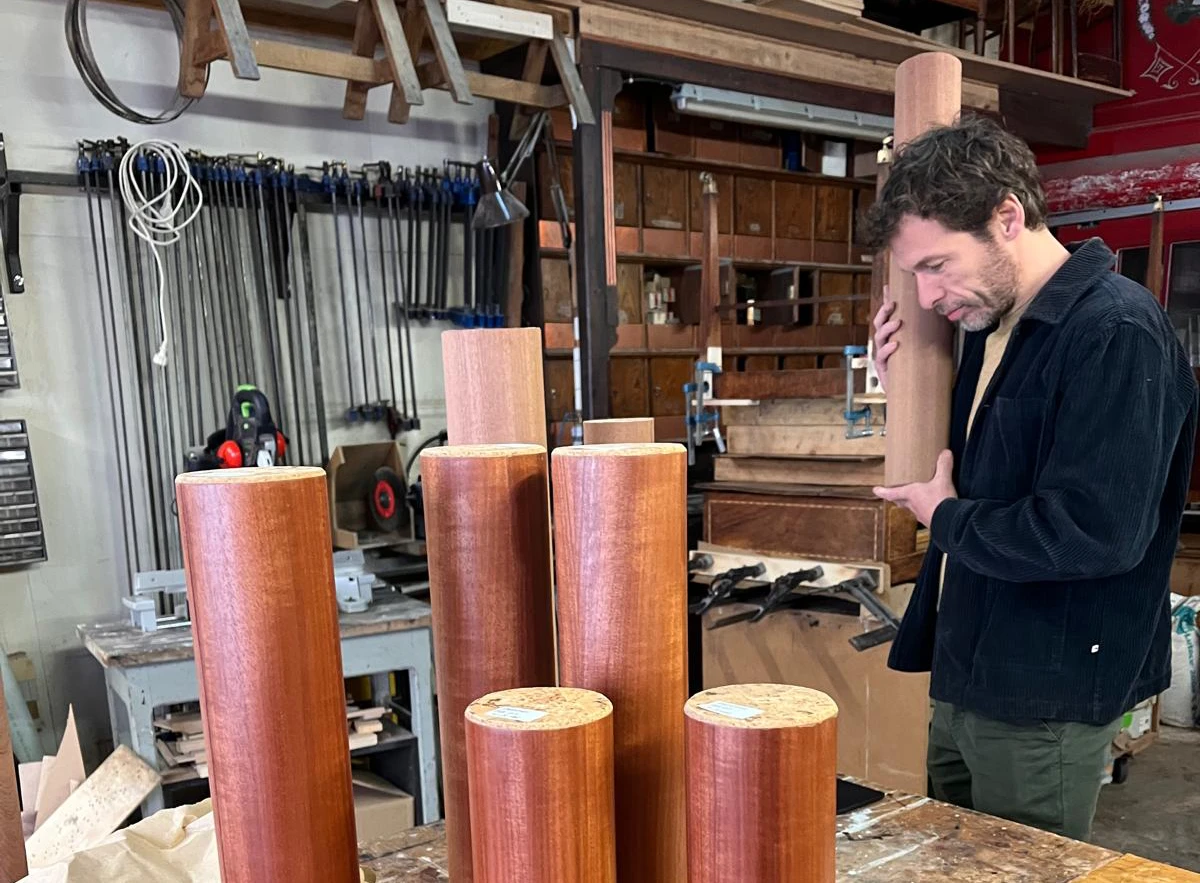
With handcrafted work, every detail matters. A joint may need to be adjusted, a fitting corrected or a finish reworked. Mickaël’s experience allows him to step in wherever necessary until the result meets the level of quality we are looking for.
Making our instruments here also means working with fewer intermediaries and having greater control over lead times and unexpected production issues. For us, having a product manufactured far away when we have both the skills and the desire to make it ourselves simply would not make much sense.
Materials chosen for the role they play in the instrument
The choice of materials is directly linked to the result we want to achieve. We need to find the right balance between acoustics, appearance, durability and production cost.
We use, among other materials, wood veneers purchased in France, cellulose manufactured in France from recycled materials, cork, glass beads and natural seeds. The seeds currently come from Germany; for everything else, we favour French suppliers and French-made materials whenever possible.
We also select the seeds and work with different combinations and arrangements inside the instrument. This forms part of our research and know-how, which we obviously do not intend to reveal in full, but these choices have a direct influence on the flow, its regularity and the sound produced.
Our research also extends to the shape of the instrument. We wanted to move away from the more angular forms traditionally associated with rain sticks and create a round, vertical object, closer to a column, with a restrained design that can naturally find its place in an interior.
An environmental approach that starts with the design
Environmental considerations genuinely influence our choices. For us, consistency begins with the way the instrument itself is made.
Whenever possible, we work with short supply chains, limit waste and choose natural or recyclable materials. Our Rainpillars contain no plastic, PVC or petrochemical-based materials, and they have been designed to be fully recyclable.
All the materials we use come from France or elsewhere in Europe. This strong commitment allows us to maintain genuine consistency between the instrument’s design, the way it is made, and the materials we choose.
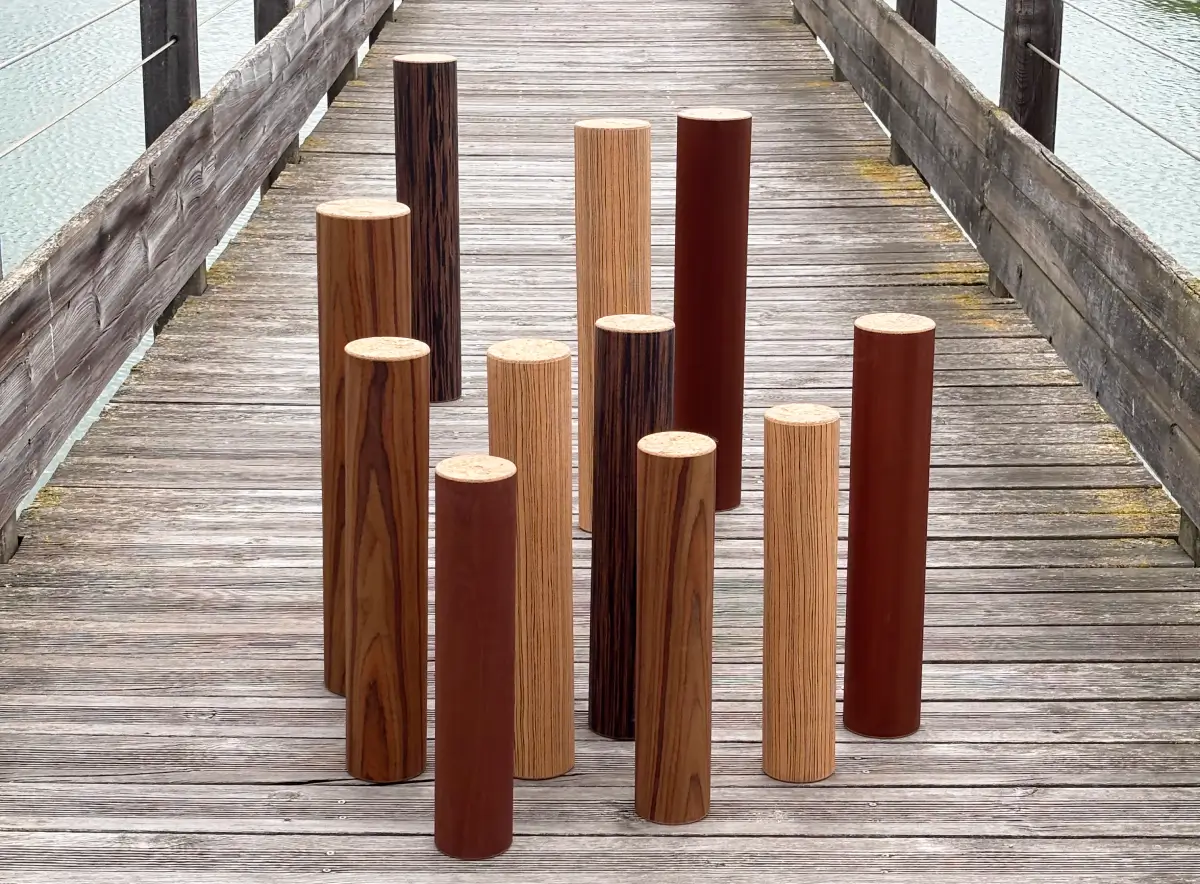
This attention extends all the way to the finishes. Mickaël prepares the natural varnishes used on the instruments himself in the workshop. The same approach continues when the instrument is shipped: both the cardboard packaging and the bubble wrap used to protect our Rainpillars are made from recycled materials.
We produce little waste in the workshop and want to remain consistent with this approach as the business grows.
Making an instrument intended in particular for the world of well-being while multiplying plastic materials, long-distance transport or less durable components would have been at odds with the way we see the project.
Two years of research before launching our first range
Our current range of Rainpillars is recent, but it comes after around two years of research, testing and prototyping.
A significant part of that work focused on the flow inside the instrument. On some of our early models, the flow could stop after a few minutes. We had to understand why, modify the design, test it again and keep working until the problem was solved.
We encountered another challenge with the consistency of the running time. An instrument could run for five minutes in one direction and noticeably less when turned over. For us, that was not good enough.
We therefore continued testing until we achieved a smooth, uninterrupted flow and very similar running times in both directions. This work is what allows us today to offer models with a stated minimum duration of 5, 8, 15, 30 or 60 minutes. To choose the right duration for your use, see our guide.
Our discussions with professionals and several music shops have also helped us improve, particularly in terms of sound and finishing. Now that the first official range is on the market, feedback from users will naturally help shape what comes next.
Finding the right balance without compromising on quality
We do not treat sound, design and craftsmanship as separate concerns. We look for the right balance between all of them.
What matters in the end is that the instrument lives up to what we have promised: the sound must match what we describe, the duration must correspond to the specifications of the model, and the finish must meet the level of quality presented on our website.
A beautiful object that sounded poor would be no more acceptable to us than a good instrument with a finish we were not proud of.
This level of care guides our decisions.
Customer service is part of the way we work
We want our relationship with customers to be straightforward, genuine and based on trust.
That starts before the purchase. Not every Rainpillar suits the same uses, and when someone is unsure which model to choose, we would rather offer genuine advice than leave them to decide alone if we can help.
That availability should not disappear once the instrument has been sold. If a problem occurs, we want to be able to look into it and find a solution, whether that involves maintenance or, whenever technically possible, a repair.
We are also developing a care kit for maintaining the wood finish. It is not yet available for sale, but it is part of our intention to help customers look after their instruments over time.
Our relationship with professionals matters just as much. Musicians, specialist retailers, well-being professionals, sound therapy and music therapy practitioners, as well as architects, interior designers and space-planning professionals all have different uses and expectations. Listening to them helps us keep learning and continue improving our instruments.
Growing, yes. Becoming an industry, no.
We want to develop Rainpillar while remaining craftsmen. That naturally places certain limits on how the project can grow, and we are fully aware of that.
We do not want to increase production at the expense of quality, choose materials that go against our principles or allow an instrument to leave the workshop if it does not meet our standards.
We also want to remain transparent about what our Rainpillars can and cannot offer. They are used for relaxation, meditation, sound therapy, music therapy and other practices connected with sound and well-being. However, we do not claim that they can heal or treat medical conditions. There is no evidence for us to make such a claim, and it is not our place to do so.
Finally, we do not want the growth of the project to make us lose sight of what made us want to create it in the first place. We are prepared to spend time researching, testing, solving technical problems and improving our instruments. But we do not want to enter a race for volume that would take away the enjoyment of this work or come at the expense of our personal and family lives.
A professional venture, and a story of friendship too
This project is also the story of two friends: Mickaël and Cédric. We have known each other for many years, but until now we had never worked together.
Rainpillar gives us the opportunity to discover another side of our friendship through a shared professional project. It brings together many of the things we enjoy: well-made objects, creativity, design, music, and the pleasure of seeing other people use and appreciate something we have created.
It is a project that inspires us, reflects who we are and brings us together.